


 LGBTQ+ Founder
 PhD Founder
 VC-Backed Founder
 Serial Entrepreneur
About
KiraGen Bio is developing off-the-shelf CAR-T therapies designed to keep fighting inside solid tumors, starting with glioblastoma, an aggressive brain cancer. We engineer immune cells to recognize two tumor targets and resist the overlapping signals cancers use to shut them down. Our KiraLOGIC platform combines AI with experimental data to identify the most promising protective gene-edit combinations to test next.
Traction & Metrics
Fundraising
$2.4M
Previous Round


Products
KiraLOGIC
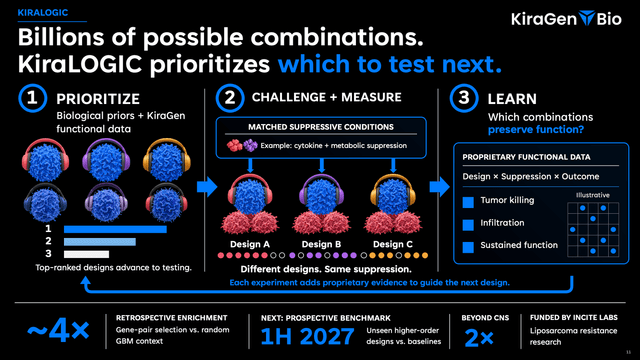
KiraLOGIC is our AI-guided platform for prioritizing protective gene-edit combinations. We combine biological priors and KiraGen functional data to select designs, test them under matched tumor-relevant suppression, and learn which combinations preserve T-cell function. Each experiment builds reusable evidence to guide the next design.
Click to read more
KGEN-001
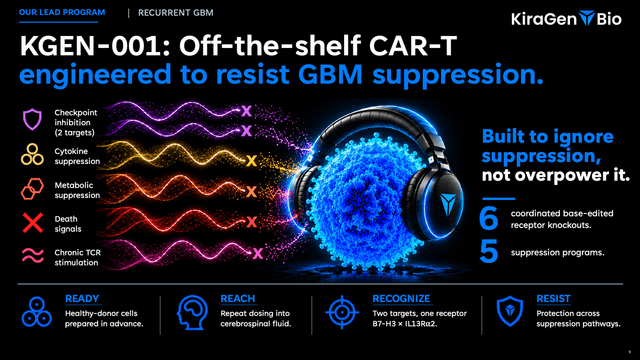
KGEN-001 is our preclinical, off-the-shelf CAR-T program for recurrent glioblastoma. It combines healthy-donor T cells, dual-target recognition, and six coordinated base edits designed to resist the overlapping signals tumors use to shut T cells down. The program is designed for repeat dosing into cerebrospinal fluid, with Development Candidate nomination targeted for Q4 2027.
Click to read more
Updates
KiraGen advances KGEN-001 into translational GBM studies
KiraGen has initiated approximately $400K in foundation-supported patient-derived tumoroid and orthotopic PDX studies for KGEN-001, our multiplex-edited, off-the-shelf CAR-T program for recurrent glioblastoma. Initial tumoroid data are expected in September 2026, followed by early orthotopic efficacy data in November and 90-day durability data in January 2027. These studies build on encouraging in vivo proof of concept and will support final candidate selection and our path toward Development Candidate nomination.
Six protective edits improved CAR-T killing in our first GBM patient-tissue study
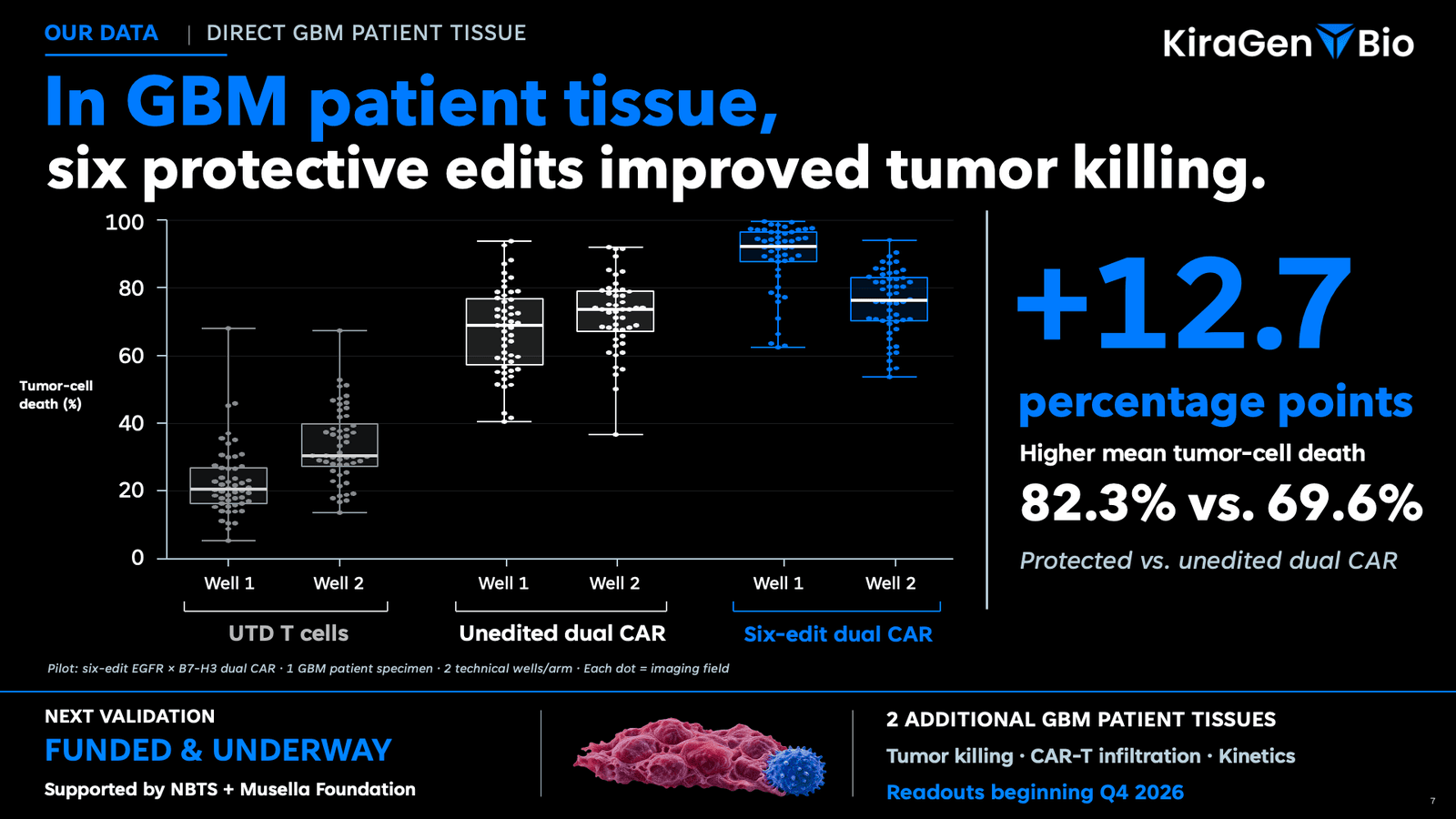
In our first experiment using tissue directly from a patient with glioblastoma, our six-edit dual-CAR design achieved 82.3% mean tumor-cell death, compared with 69.6% for the unedited dual-CAR comparator, a 12.7 percentage-point improvement. This is an encouraging early ex vivo result from one patient specimen, with two technical wells per arm. The next question is whether the advantage reproduces across patients and translates into better tumor control in the brain. Studies in two additional GBM patient tissues and orthotopic brain-tumor models are funded and underway, supported by the National Brain Tumor Society and Musella Foundation. These studies will guide final validation of our planned KGEN-001 lead as we advance toward Development Candidate nomination in Q4 2027.
Three GBM patient tumors show improved CAR-T killing and infiltration
Building on our initial results, KiraGen has now received data from three independent glioblastoma patient-tissue samples. Our six-edit, dual-target CAR-T cells demonstrated improved tumor killing and infiltration compared with unedited CAR-T cells, providing early evidence that the same off-the-shelf design can function across different patients' tumor environments. In parallel, an ongoing mouse study using patient-derived GBM cells implanted directly in the brain is showing early signs of CAR-T activity. Together, these findings strengthen the translational evidence for our approach to overcoming tumor suppression, with additional in vivo results forthcoming.